
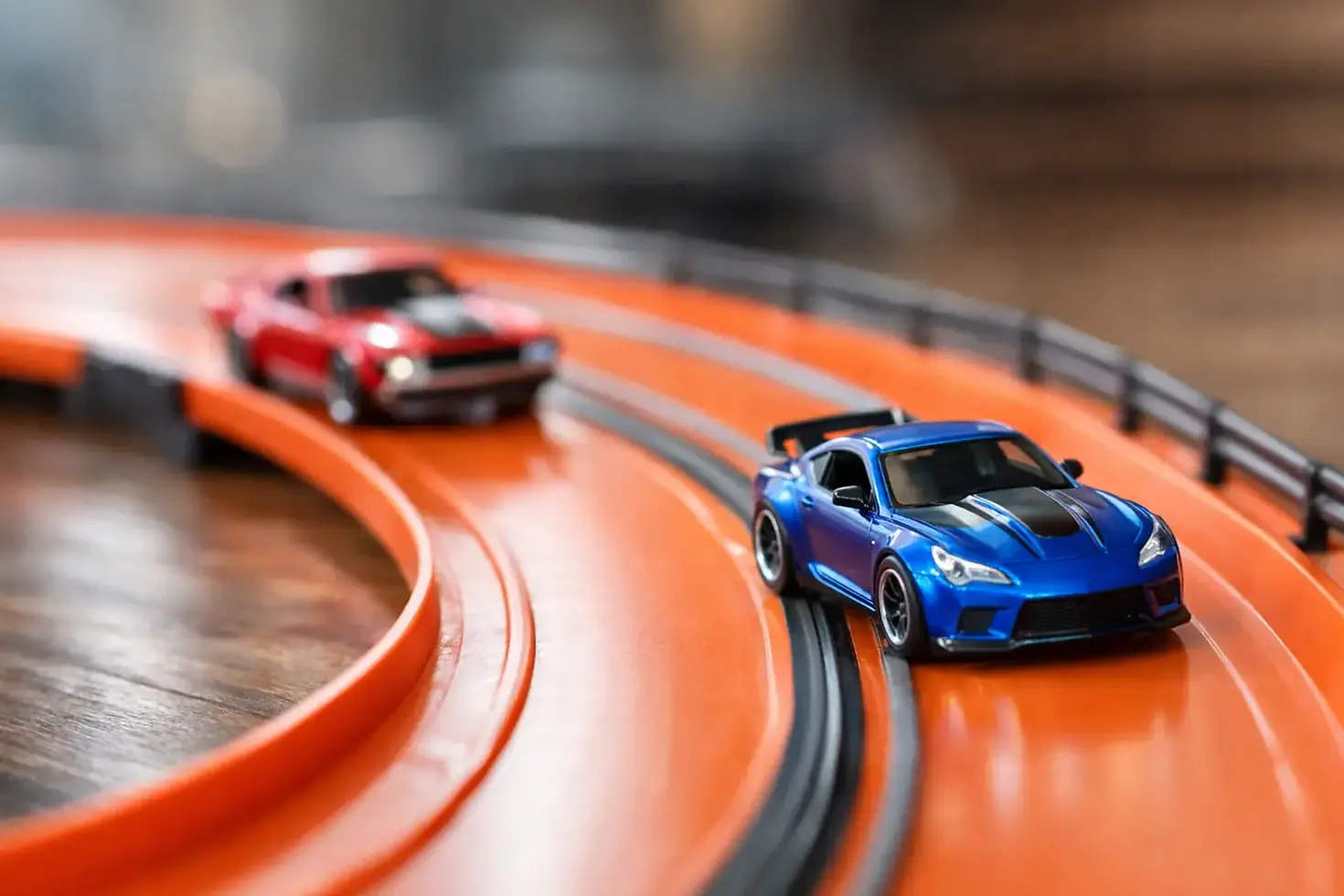
Why Do Diecast Cars Slow Down on the Track?
A car can look fast at the starting gate, carry good weight, and still give away time before it reaches the finish. Why do diecast cars slow down? Usually, the answer is not one dramatic failure. It is a stack of tiny losses: wheel rub, axle friction, poor alignment, unstable weight transfer, or a body that catches the track at the wrong moment. In gravity racing, every fraction matters.
At 1:64 scale, there is no motor to cover up a bad setup. Your car gets one shot of potential energy at the top of the course. From there, race control only records what the build can deliver. The fastest cars do not simply roll downhill. They conserve speed through the straights, stay composed through the bends, and cross the timing line without scrubbing off momentum.
Why Do Diecast Cars Slow Down? Friction Wins
Gravity gives a diecast car its launch energy, but friction starts taking it back immediately. Friction is not just what happens when a wheel stops spinning. It includes every point where moving parts touch, drag, wobble, or flex.
The biggest source is often the wheel-and-axle system. If an axle is bent, dirty, rough, or pinched by the chassis, the wheels cannot rotate freely. A car may still roll across a tabletop and seem fine, yet lose serious speed under load on a long course. A quick hand spin is useful, but it is not the whole test. The car needs to roll cleanly while carrying its own weight and handling changes in direction.
Wheel rub is another common culprit. The inside edge of a wheel may touch the body, chassis, fender, or a burr near the axle opening. Even light contact creates drag. On a straight section, that drag quietly bleeds speed. In a corner, it can pull the car off line or make it hesitate when it should be carrying momentum.
Dirty axles and wheels matter, too. Dust, old lubricant, tape residue, and tiny pieces of track debris can create inconsistent runs. One pass may look strong. The next may be noticeably slower. For a car headed to timed race day, consistency is performance.
Alignment Determines Whether Speed Stays on the Car
A diecast car can have fast-spinning wheels and still run slow if it cannot hold a clean line. Alignment determines where the car wants to go once gravity gets it moving.
If the front end steers slightly left or right, the car may drift into a rail, curb, wall, or track edge. That contact costs speed fast. More importantly, it can upset the car for the next bend. A light brush that seems harmless at the top of the course can become a major time loss by the bottom.
Rear axle alignment is just as critical. A rear wheel that sits unevenly or a rear axle that is not square can make the car crab down the track. Instead of rolling forward efficiently, it is constantly correcting itself. That is wasted energy.
Check alignment on a flat, smooth surface. Give the car a gentle, straight push and watch its path. Does it track cleanly? Does it arc hard to one side? Does it wobble, twitch, or suddenly change direction? Those are not cosmetic quirks. They are clues from the chassis.
A perfectly straight runner is not always the winner on every course. On a road course with multiple bends, a build may need controlled stability more than absolute free-roll. But a car that repeatedly hunts for the wall is giving away time before the real racing begins.
Weight Helps Until It Hurts
Weight is one of the most talked-about tuning tools in diecast racing, and for good reason. A heavier car can carry momentum well, especially through transitions and small imperfections. But more weight is not an automatic speed upgrade.
Weight that is too far forward can overload the front wheels, increasing friction and making the car less willing to rotate through turns. Weight that sits too high raises the center of gravity. That can make a car tippy, unstable, or prone to bouncing when it hits a change in track surface.
A rear-biased setup may help a car carry speed, but too much rear weight can make the front end light and vague. The car may wander instead of tracking with confidence. The right balance depends on the rules, the body style, the wheelbase, and the course itself.
Think of weight as placement, not just total mass. A well-balanced car keeps all four wheels doing useful work. It does not pitch forward under braking forces from a corner, hop through a transition, or lean hard enough to scrub a wheel against the body.
Before adding material, know the class rules. A fast build that fails inspection never reaches the grid. Clean, legal performance beats a clever modification that race control has to reject.
Wheel Choice and Condition Can Change a Run
Not all diecast wheels behave the same. Wheel width, tread shape, material, axle fit, and hub design all affect rolling resistance. A wheel that appears smooth may have a molded seam, warped tread, or uneven bore that causes a subtle bounce at speed.
Watch for wheel wobble. If a wheel rocks side to side as it spins, it may be rubbing intermittently or lifting part of the car’s weight off the track. That creates a rolling loss that gets worse as speed builds. A car does not need a visibly broken wheel to suffer from it.
There is also a trade-off between free rolling and control. Extremely low-resistance wheels sound ideal, but a setup that is too loose may be less stable in corners or over uneven sections. The goal is not to build a car that looks fastest in your hand. The goal is to build one that posts a fast, repeatable time on the course.
The Track Exposes Problems a Tabletop Cannot
A short kitchen-table test can reveal obvious drag, but it cannot fully simulate a gravity road course. Straights show whether the car can maintain speed. Turns reveal alignment and weight-transfer problems. Surface changes expose wheel chatter. A car that dominates a simple straight ramp may lose ground when the course asks it to stay planted through a sequence of bends.
That is why filmed competition matters. It gives builders more than a finish position. You can watch where the car gains, where it fades, and how it behaves under real race conditions. Did it leave the gate cleanly but slow in the middle? Did it contact the edge in a turn? Did it look planted while another car bounced? Those details give you a next-step tuning plan.
At Timber Creek Speedway, the course is part of the challenge. Your build is not being judged by shelf appeal alone. It has to earn its place through inspection, timing, and visible on-track performance. REAL RACING. SMALL SCALE.
A Practical Pre-Race Check
Before you pack your entry, inspect the car like a crew chief. Spin each wheel and look for rubbing or wobble. Check that the axles are straight and secure. Roll the car on a flat surface to see whether it pulls or drifts. Look underneath for anything hanging low enough to contact the track.
Then check the body. Loose windows, bumpers, interior pieces, or added components can shift under motion or create contact points you did not expect. Make sure any permitted weight is firmly attached and positioned intentionally. A car should feel solid, not rattly.
Finally, keep expectations realistic when you make one change. If you adjust weight, wheel spacing, and axle setup all at once, you will not know which change helped or hurt. Tune in small steps. Test. Observe. Repeat. That is how a garage build becomes a contender.
Slow diecast cars are rarely hopeless. Most are simply telling you where energy is being lost. Listen to the run, watch the line, make one smart adjustment, and send your next build to the grid ready to prove itself.


Comments